Learning Out Loud: Reflections from the Service Innovation Summit 2026
Team Cisco! Marco Montero (left) and Tab Berger (right) at the Member’s Summit 2026
Last week, I had the pleasure of attending the Consortium for Service Innovation’s Annual Member’s Summit. Cisco has been using Knowledge Centered Service (KCS®) in their Duo Security business since 2015, but as a first time attendee, this was a new opportunity to learn from and make connections with other businesses that truly recognize the value of organizational knowledge. I found the community as welcoming as they were passionate about improving the way we serve our customers and I walked away refreshed, recharged, and with new ideas I could take back to my team at Cisco.

We couldn’t have asked for better weather and enjoyed many meals outdoors under the palm trees 🌴
The 2026 Member’s Summit was held at Hotel Valley Ho in Phoenix, Arizona. The schedule was an even balance of presentations, breakout sessions, open space, happy hours, and shared meals, allowing for many different types of meaningful connections to grow between attendees. With 120 participants, I had not had this level of in-person collaboration since before the COVID-19 pandemic, and this event underscored for me how truly transformative the power of human-to-human connection can be.
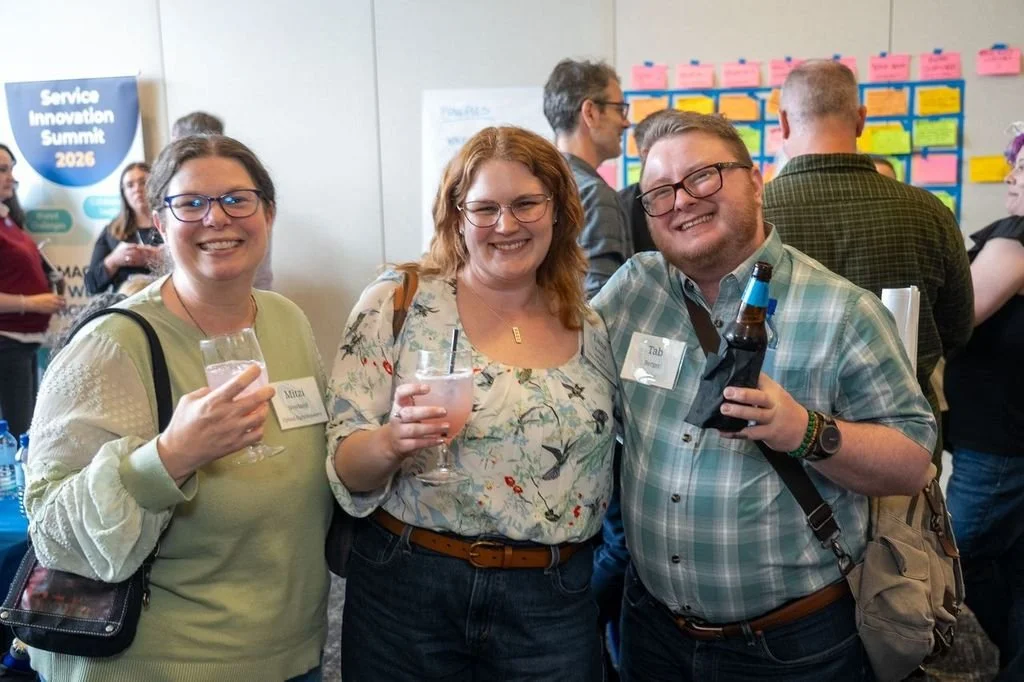
Making new friends at happy hour
AI was the number one thing on everyone’s mind, and there were no discussions or conversations that did not mention the innovation happening in the field. What’s exciting to see is that even though KCS was created 35 years ago, it has this sudden resurgence in relevance due to AI’s demand for accurate data. What I really appreciated about this group is that even though AI’s technological advances are being embraced and incorporated into our practices, we always returned to the human.
The value of human knowledge remains an essential part of the process. We will always be innovating our products and it was emphasized during the opening keynote that until an engineering team can make a product with absolutely no bugs, there will always be a need for a customer support.
In addition to traditional talks and presentations, the Member’s Summit features an Open Space day, a “facilitation technique that capitalizes on the collective experience and intellectual capabilities of those present. [1]” This gave the attendees power to suggest topics, build the agenda, and choose which session to attend and focus on the issues that really matter to their businesses. Instead of hearing from just a handful of presenters, the Open Space sessions were small, collaborative groups where everyone had a chance to speak. I found the discussions to be incredibly insightful and I walked away from each one with ideas on how we might tackle particular issues.
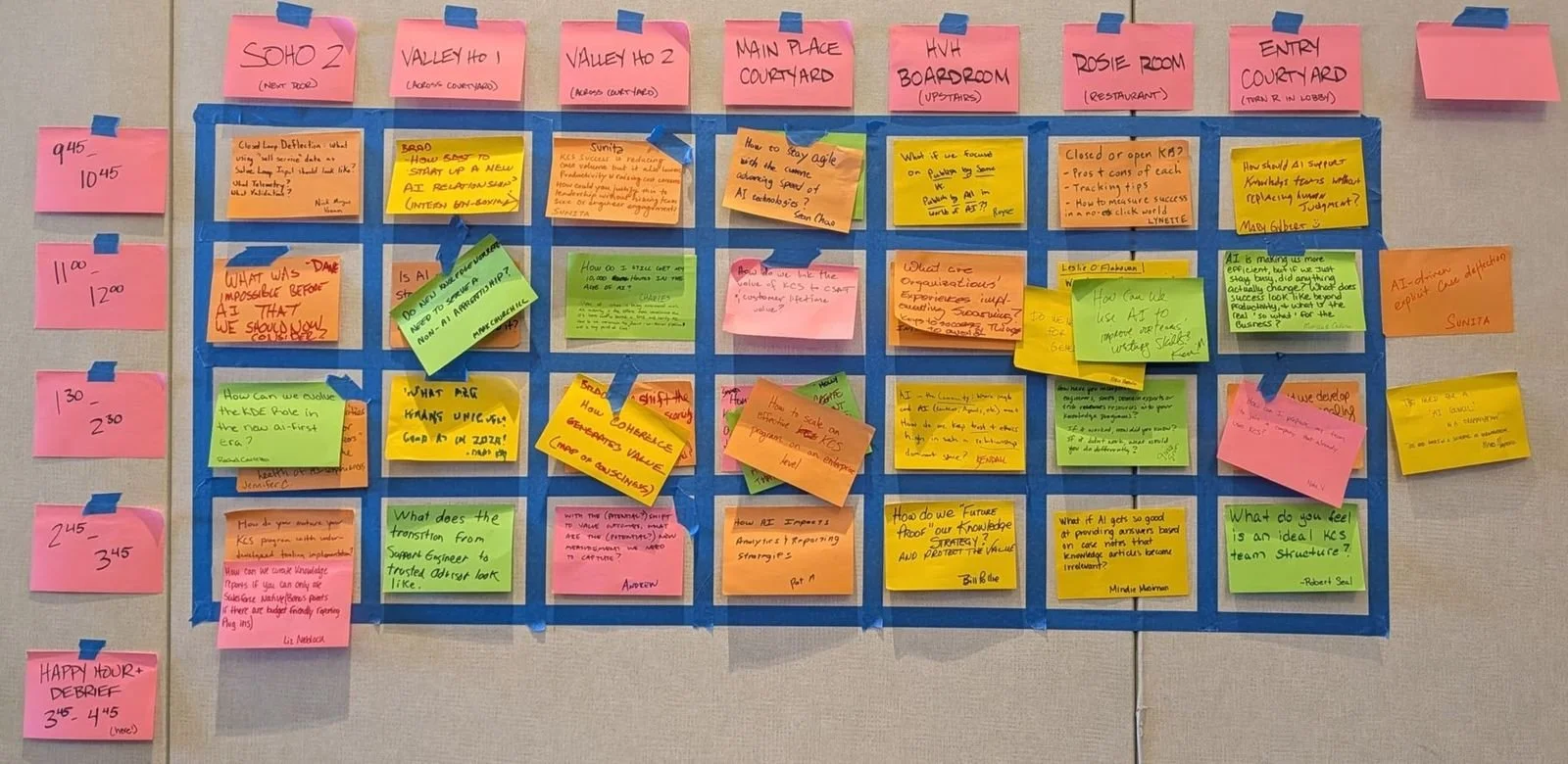
The schedule on Open Space day, selected and facilitated 100% by the attendees
Presenting on KCS at Cisco
I was fortunate enough to be invited to present on KCS and AI: Designing for Agnostic Use Cases in an AI-First Environment. This talk encompassed our experience of rolling out KCS at Cisco over the past year. Our Design Phase brought together multiple diverse business groups under a unified mission, taking the mature KCS practices from our Duo and Splunk businesses and collaborating with the wider Cisco teams to build an AI-first, KCS workflow for our support engineers.
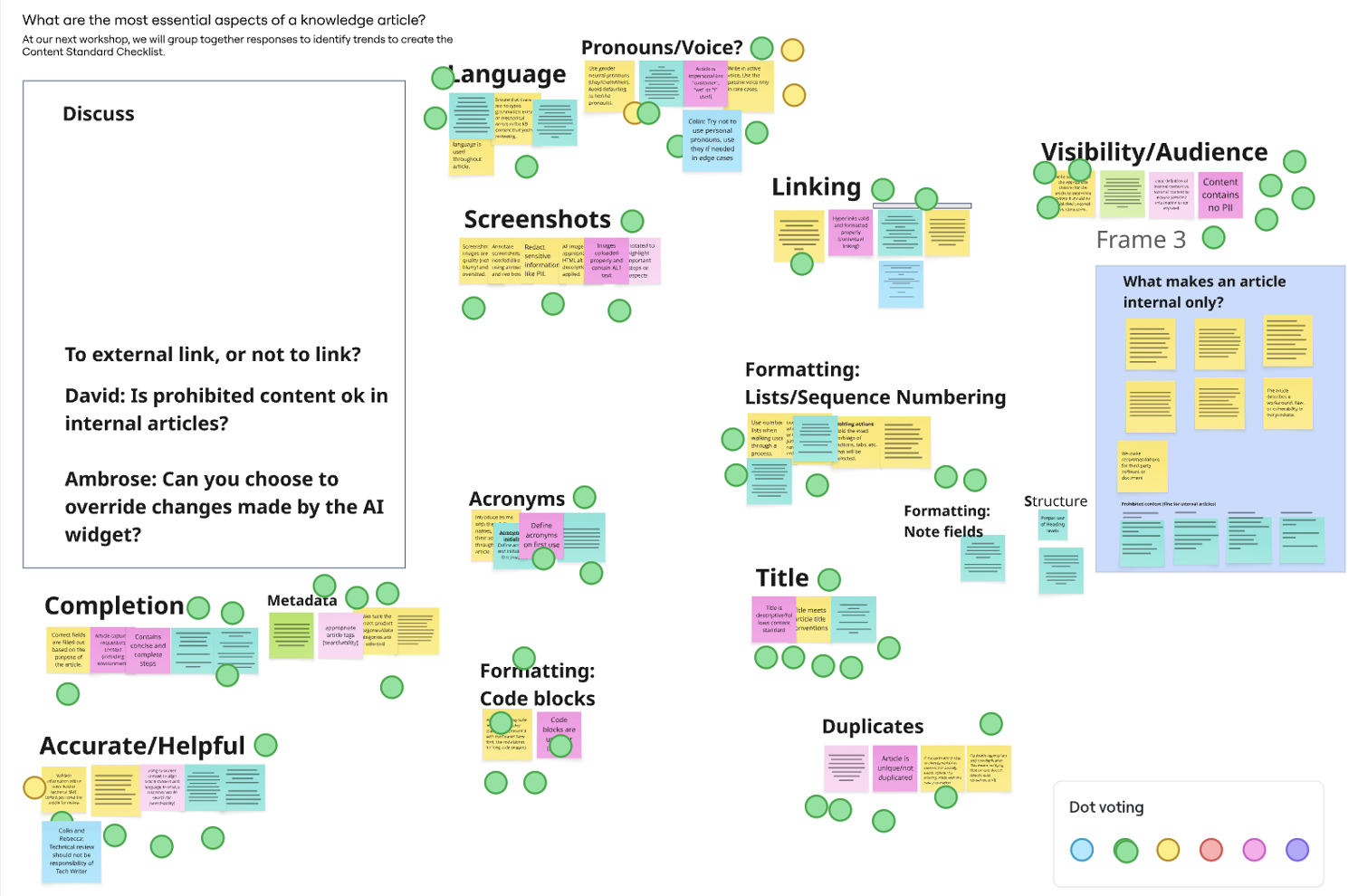
Our Design Phase included a highly collaborative Content Standard Workshop where Splunk, Duo, and Cisco teams worked together in Miro to consolidate standards into a unified set of guidelines.
The KACES Widget
Our AI-powered solution to knowledge management – the KACES (Knowledge Article Creation and Enhancement System) Widget — bridges together our Salesforce and Khoros systems to better incorporate knowledge into the engineer’s workflow. This application of agnostic use case engineering allowed us to begin to bridge gaps across systems and begin to structure content in the same way across fragmented systems.
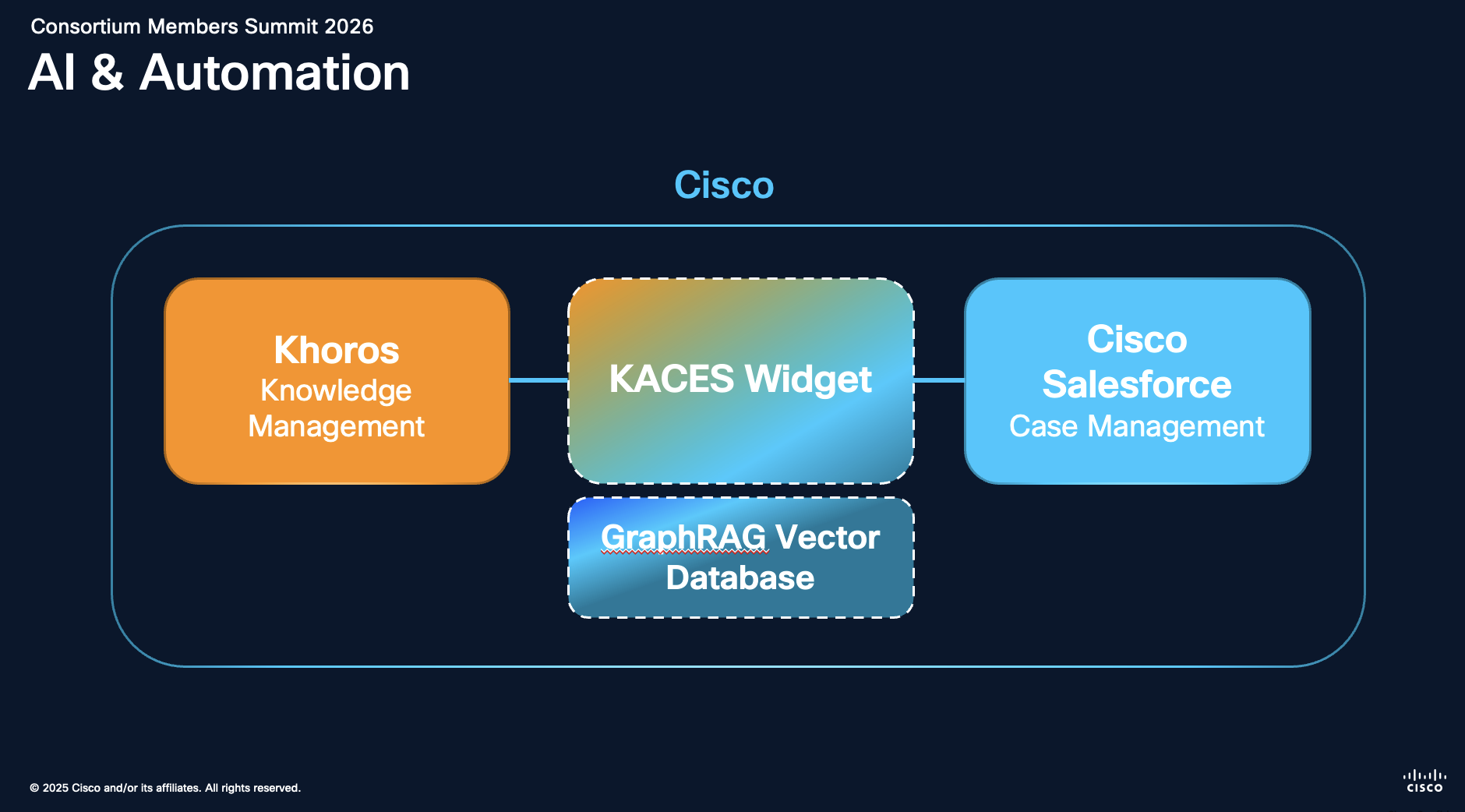
KACES bridges together the Salesforce and Khoros systems to incorporate knowledge into the engineer’s workflow.
Turning case notes into value
The key differentiator for KACES is its ability to generate article drafts based on SR case notes. This transforms customer context that’s being captured by engineers every day into the first draft of a knowledge base article, complete with our style guide and content standard. As powerful as this is, the engineer acting as the human-in-the-loop is essential to ensure that everything captured in the article is technically accurate and contains all the information a customer needs to resolve the issue.
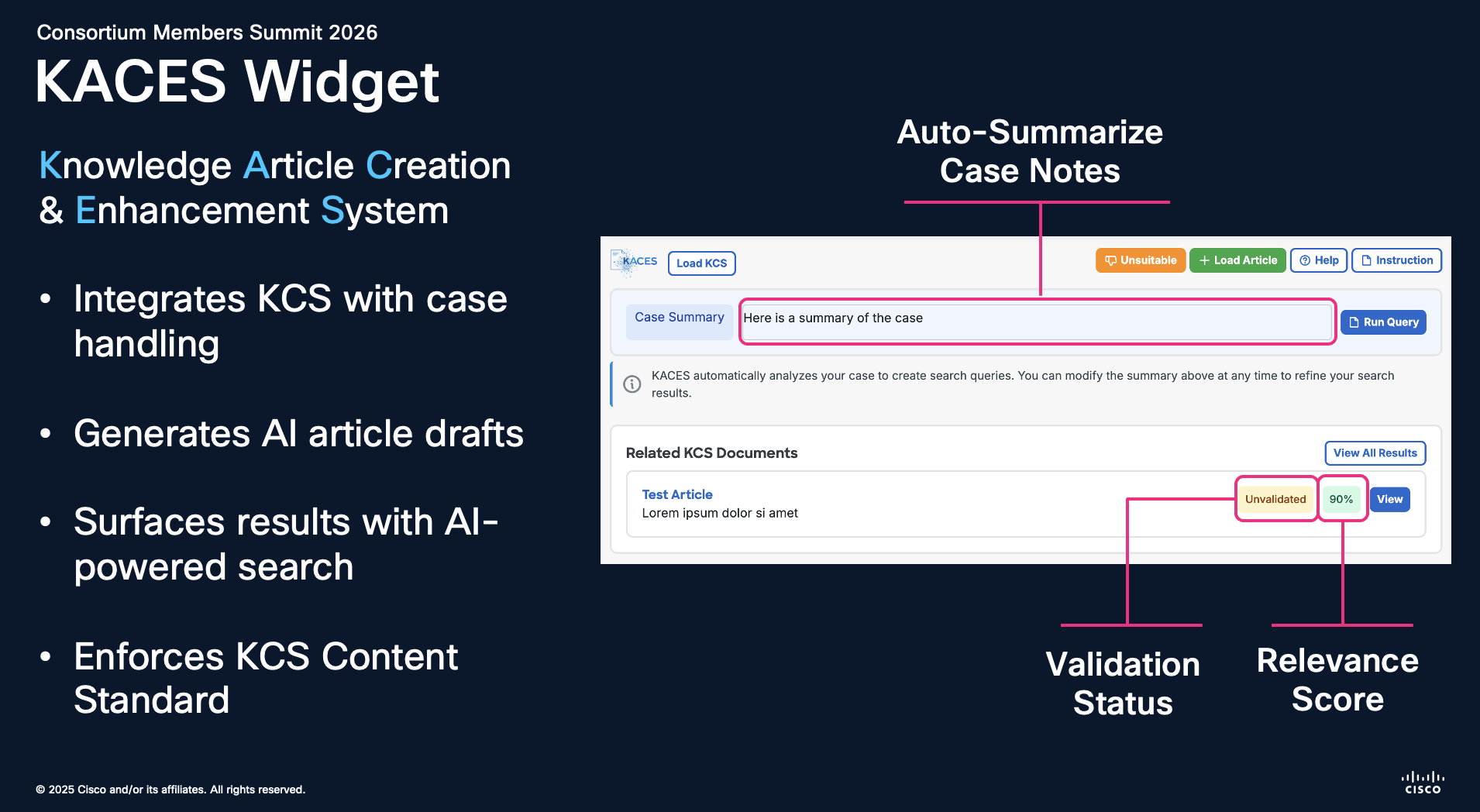
The KACES Widget features an AI-Powered case summary, relevancy score, and validation status. It also enforces our article template and content standard style guidelines.
A sea of complexity
Finally, I spoke about the complexities of change management at scale in a large organization. I related working at smaller companies to being in a lake, where it’s easier to get from point A to point B, and big companies to an ocean that is constantly in motion.
A lake and an ocean are both bodies of water, but they behave very differently. The sheer size and depth of an ocean means there are overlapping interactions as tides, currents, and weather converge. Each acquisition takes an entire company, with its own practices and systems, and places it into a new system. This adds a whole new “body of water” into an already complex environment. This complexity may include:
Greater scale (7,000+ knowledge workers)
Change takes much longer
Time zones with global teams complicates scheduling
Many more stakeholders
Timeliness of leadership communications
Interlocking initiatives may slow progress
What I found after discussing this with other leaders following my talk is these are common challenges across large organizations. Like the waves of the ocean, these contradictions are the natural complexity of a huge amount of people working together where constant change is the norm.
Overall, the KACES Widget is continuing to improve and the development team is working on enhancements to better communicate with Salesforce Knowledge. We also have a new dedicated KCS Center of Excellence team, composed of knowledge leads from Splunk, Duo, and other Cisco groups. So far we are working great together and our team has enabled 165 engineers. I couldn’t ask for a better group of people to work with and Cisco’s future of knowledge is in great hands!
Open Space Discussion: Scaling KCS in Complex Environments
After giving my presentation, several attendees from other companies approached me and related to the challenges we were facing. Companies who had gone through acquisitions, have 1,000+ knowledge workers, and high degrees of internal complexity had faced similar challenges in their KCS rollout and we decided to dedicate an hour during Open Space to discuss them further.
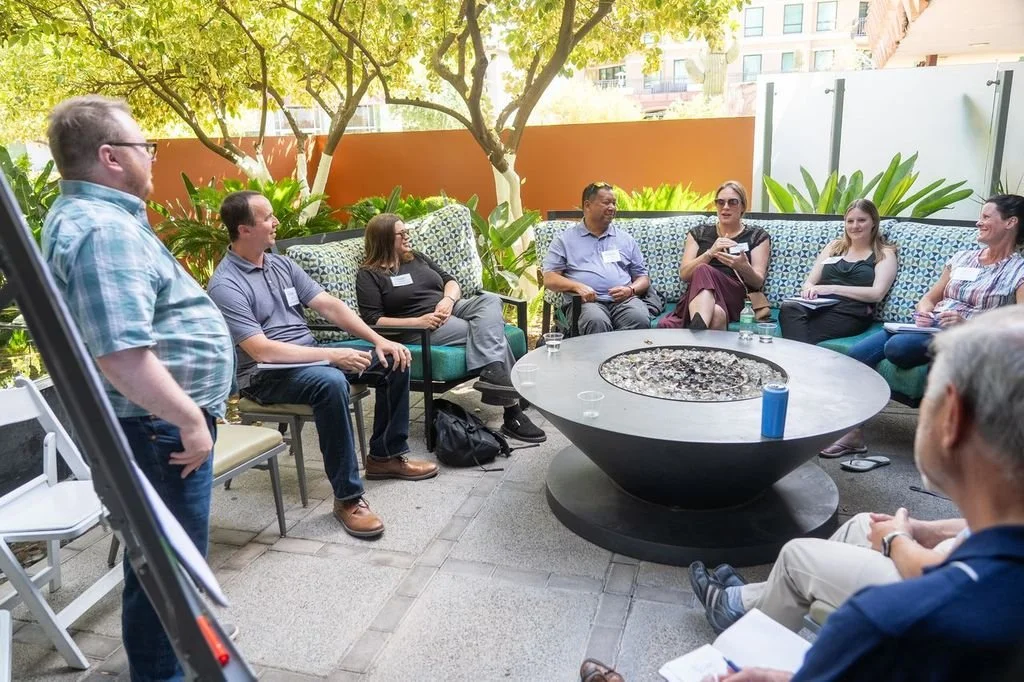
KCS with Complexity “Support Group”
How do we define “complexity”?
We started off the discussion by identified what made our organizations particularly complicated to facilitate a traditional KCS implementation in, which led us to identify several key challenges shared almost unanimously across the group:
Acquisitions
Many products (taxonomy)
Many customer personas
Structure and knowledge segmentation
Large number of knowledge workers
Job roles of knowledge workers
Non-unanimous buy-in of KCS at leadership level
Organizational silos
Differing levels of KCS maturity across teams
Different knowledge workflows across teams
Integration and data migration
We discussed the first topic of “Acquisitions” in more detail and made several key observations, namely that almost everyone in the group had gone through data migrations and had to, at some point, conduct a massive content clean-up. The format, field mapping, taxonomy— challenges we had all faced internally at Cisco—were shared challenges in companies with a high degree of complexity.
The need to define where knowledge management and KCS sits in the acquisition plan
Seperate the process from the workflow “The workflow drives the tools, not the other way around”.
Aim to measure success based on the same metrics, OR note the process and understand where metrics may need to be adjusted
Incorporate or update the onboarding process to include KCS, as different teams may have different education pathways
KCS will need to be built into the job role across newly onboarded teams
KCS Coaching can help scale KCS across very large teams (1,000+), but need to emphasize “Structure before scale”.
Getting dedicated headcount for knowledge management remains a challenge
While these issues require much more than an hour to discuss, we agreed to continue the discussion post-conference to keep diving into this complexity together. Following the discussion at Happy Hour, I had the opportunity to connect with others who have managed very large KCS implementations (4,000+) and learned that they had managed “big bang” style rollouts of KCS, taking various approaches to enable the coaches on a large scale, something we can potentially learn from at Cisco.
The topics we discussed during these enriching conversations are not currently noted in the KCS Adoption and Transformation Guide, so we see a rich opportunity to document these practices used successfully in other teams to help other KCS teams make their projects more successful.
See you next year!
This was easily the most valuable and well-organized professional conference I have attended and is well worth the cost of your ticket. I had a fantastic time connecting with others in the knowledge management space and am looking forward to returning in 2027!
KCS® is a service mark of the Consortium for Service Innovation™.
References
1 - https://www.serviceinnovation.org/service-innovation-summit-2026-agenda/