More than a museum: Bordeaux’s proposed House of Slavery and Resistance
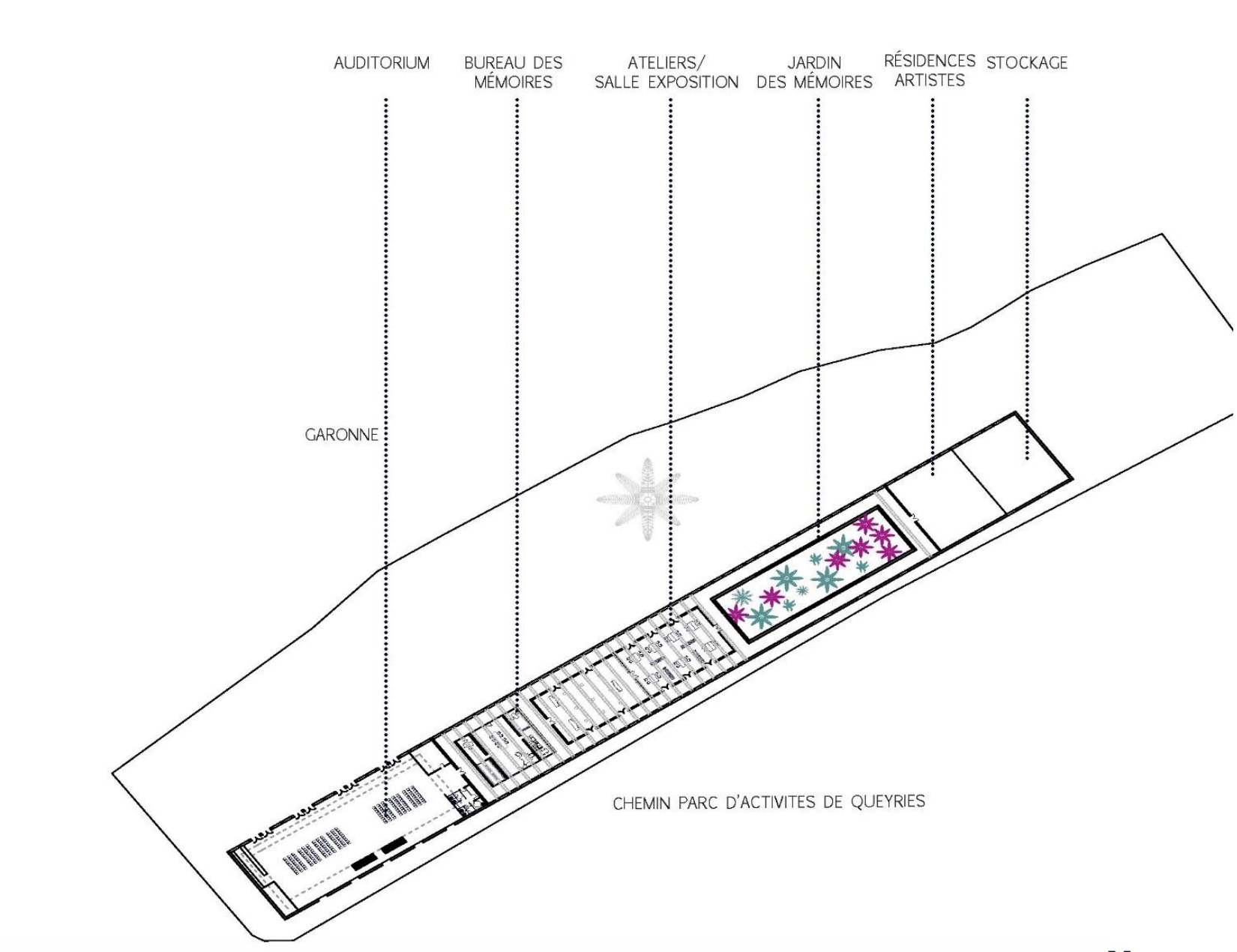
A plan for Maison Esclavages et Résistances on the banks of the Garonne river, including an auditorium, Office of Memories, workshops, exhibitions, Garden of Memories, artist residences, and a park. Created by Mémoires et Partages (Source)
As the Assemblée Nationale votes to finally repeal the heinous Code Noir (Black Code), Bordeaux activists propose a new educational and memorial center called the Maison Esclavages et Résistances (House of Slavery and Resistance), teaching the history and legacy of slavery in a city that was once the second-largest slave trading port in France.
“I welcomed this announcement with satisfaction, but also with lucidity,” Karfa Diallo, founder and director of Mémoires et Partages (Memories and Sharing), said of the repeal of the Code Noir. “Satisfaction because it is important that a text which legally organized the dehumanization of millions of men, women and children is finally explicitly rejected by the Republic. Lucidity, because this repeal comes more than three centuries after its promulgation and more than 170 years after the final abolition of slavery. It reveals how certain chapters of our history have long been pushed to the margins of the national narrative.”
Founded in Bordeaux in 1998, Mémoires et Partages works in cities across France and Senegal to teach about the shared memory of colonization, slavery, racism and the struggle for human rights.
In 2023, Mémoires et Partages proposed a bold new way to teach — an educational and memorial center called Maison Esclavages et Résistances (House of Slavery and Resistance) in Bordeaux.
“The Code Noir turned these men, women, and children into property,” said Aurélie Bambuck, author of Pacotille, l'enfant esclave and director of Au nom de nos ancêtres, esclaves et négociants. “Now, the work of reparation will be to truly restore them to their place within humanity and to bring to light the humanity they never lost,” she said.
According to Bambuck, reparations include projects like Maison Esclavages et Résistances that acknowledge and address the legacy of slavery through public memory and education.
“The awareness in Bordeaux of the legacy of the slave trade, as well as the involvement of the city's socioeconomic elites in the plantation economy in the colonies, is relatively recent,” said Clément Piquet, a slave trade researcher from the University of Bordeaux Montaigne. It was not until 1995 that the first scholarly work on the issue was published.
Bordeaux has taken concrete steps over the past decades to confront its monstrous history with several public memorials across the city. In June 2020, Bordeaux became the first city in France to put up explanatory panels on streets named after people tied to the slave trade. The panels describe how their namesake participated in slavery, a success that Diallo attributes to the Black Lives Matter movement.
A permanent exhibition was opened in 2009 at the Musée d’Aquitaine (Museum of Aquitaine) to educate the public on the city’s role in transporting slaves.
The current progress in Bordeaux would have been “unthinkable” only a few decades ago, said Diallo.
In May 2001, France adopted the Taubira Law, which recognizes the slave trade as a crime against humanity. The law mandates that educational programs include historical information about this period, making slavery part of school curricula across France.
From Bambuck’s experience, the effectiveness of these programs is evident in the students. “I was happy to see that they were aware of this history that I wasn't in my time. I studied in the late ‘90s and back then, slavery was not studied in educational programs.”
According to a report completed by Mémoires et Partages, existing educational and memorial efforts are acknowledged as important, but currently insufficient.
Maison Esclavages et Résistances would complement, not replace, school curricula and the Musée d'Aquitaine, and serve as an additional resource for educators. It would showcase stories of resistance by enslaved people and link the legacy of slavery to modern racism, a challenge not readily addressed by traditional school and museum formats.
“It’s not just about looking at the past, but about better understanding the present in order to build a more just future,” said Diallo.
While the Maison Esclavages et Résistances is still under discussion with city officials, the repeal of the Code Noir offers an opportunity for more discussion on Bordeaux's colonial history and expanding public education efforts.